21 November 2016

Spark MIT 2017

Wonderful day spent with 2016 Spark MIT teachers at Spark headquarters in the city today.


I was very privileged to be part of the group this year in a mentoring role alongside Dorothy Burt.

Today teachers shared the impact of their inquiry both for their students and for their own teaching practice. There was some impressive achievement data shared as well anecdotes and personal voice from students showing the outcomes of innovation.

Many in the group talked about how they were building on their inquiry for next year and the model of teaching as inquiry was very evident in their mindset.

17 October 2016

Collaborative Inquiry Meeting - Give a Little Get a Little

This afternoon instead of our usual staff meeting our collaborative inquiry groups met together. 
Each teacher had to Give a little - a piece of advice, and get a little - come with a problem for others to solve.

Each group of 6-7 teachers went off to a room with afternoon tea and spent about an hour sharing.


Teachers had been forewarned to bring a gem that they had learned this year through their inquiry into practice. These came thick and fast. Some of the advice that was shared was in the form of warnings - what not to do. Others examples were from successful trials such as giving boys a short set times using a visible times to complete tasks or creating a bank of reading texts recorded by the teacher for students to revisit.


I thought this would be easier, we had a similar 'Agony Aunt' inquiry meeting last year that was very popular. This year, in the group I sat in anyway, teachers found it hard to define a problem for others to solve. There were general or broad issues such a 'the kids don't write enough' or 'kids are out of class so often' These needed to be teased out into exactly what were the gaps in writing or when are students out of the class and what are they missing out on. 

The possible solutions for these problems created great discussion. Having teachers from different ages meant junior teachers were able to teachers from older classes suggestions and vice versa. There was also a lot if input from the two beginning teachers in our group who had a new and different perspective on how things are done.

A successful format for an inquiry meeting as long as teachers have time to think about and prepare their pieces of advice and their problem.


23 September 2016

Reading Milage


In New Zealand teachers are able to select the length and number of texts they provide for their students to read in class, thus influencing reading mileage. 


In New Zealand we have both freedom and responsibility to select texts for students and are free to gather resources from far and wide, including the internet. 


There are so many decisions teachers need to make about reading mileage.


According to Duke and Pearson developing reading comprehension involves a great deal of time and opportunity to read. They explain that as with decoding in the earlier developmental stages of reading, all the explicit teaching in the world will not make students strong readers unless it is accompanied by lots of experience applying knowledge, skills and strategies during actual reading. There are several studies that indicate when an extensive range of reading material is available and students read a large number of books, their achievement accelerates.

How are our upper primary teachers managing to support this reading mileage?


8 August 2016

Getting Gains in Manaiakalani Schools


A summary of some of the research Woolf Fisher Researchers shared with Manaiakalani leaders about the significance of sharing and connecting visibly.

21 July 2016

Sharing our Teaching as Inquiry

Dorothy Burt led a wonderful Manaiakalani PLG for 'new to digital device' teachers in our cluster. In Term 1 and 2 the focus was Learn, the Create so this term we were looking at Share. 

One of the activities we did was to look at our own teaching inquiry and share with teachers from other schools what we did, particularly how we shared our learning.


Then teachers recorded some of their reflections, both from what they heard from others teachers, and about their own inquiry process. I was very interested in what teachers had to say about the sharing of their own learning.

"I like the idea of sharing my learning with staff, rather than just to the appraiser."

I liked this because it made me think about the affordances of technology that we know empowers our young learners by giving them a real audience as well as feedback from others.  

"My inquiry is a common problem - other schools are doing the same thing. Why are we not communicating cross-school to share what we are doing?

This one I thought was a great idea, what a wonderful model for our students!

"Maybe sharing the teaching inquiry with the students."

And this comment summed up how we should go about the process of teaching as inquiry
"Just that there are lots of different ways to do Inquiry and no single right way. Every school, teacher and student has different needs and it’s important we cater to those individual learning needs."

16 June 2016

Arrest the Summer Drop-off

Rachel Williams,a researcher at the Woolf Fisher Research Centre at the University of Auckland shared some of the research findings of her pilot study of a blogging programme that she developed to address the literacy slump that occurs during summer holidays.


She found that learners who participated in the Manaiakalani Summer blogging programme did not experience a significant drop off in their test scores as measured by the e-asttle writing test.
The blue line on the graph shows the summer bloggers test scores over the year. The red line shows a matched sample of learners who did not blog over the summer (matching gender, ethnicity and achievement) . Students who didn't participate in this continued learning over the holiday through blogging show the trend we are familiar with - that writing outcomes rise through the school year and slide over the summer break.


12 May 2016

Critical Friends

This term we are using a bonus reliever allowance we received to release teachers to observe one another during reading.


Teachers are in groups of 3 and each get release  an hour to visit their reading buddies during reading time. This a chance to see colleagues teaching at different levels and see some new ideas,. But most importantly it is to act as critical friends and support teachers inquiry into their own practice.

The time tabeling has been quite a mission but we have a schedule for the next few weeks for teachers from mixed syndicate levels (the colour codes) to visit one another.

The expectation is that your colleagues will be teaching reading during your visit of half an hour.

By the end of the cycle all of our teachers would have had 2 colleagues see their reading lessons.


In week 8 instead of our normal collaborative inquiry group meetings we are meeting just in our groups of 3 to act as critical friends for one another.

Feedback from teachers so far is that they are really enjoying seeing others teach. Apart from beginning teachers using their PRT release for observations, it is a rare opportunity to be out of class and observe colleagues.

I'm looking forward to the learning conversations that come out of these reflective meetings.


7 April 2016

Where are we up to?


At the end of Term 1 I shared with my inquiry group what looks different in my practice. My Inquiry is how to get our teachers effectively inquiring into their practice. and there are some things I learnt in 2015 that I hope will help.

4 March 2016

Inquiry Start-up For 2016

Into a new year of teaching inquiry. 


After feedback from staff last year we have made the start up a little later so it was this week, (week 5) before we met for the first time to share our inquiry in collaborative groups.
This slightly slower start was to take pressure off busy teachers at the beginning of the year and give them time to think about what they really needed to inquire into. It also meant that some of the beginning of the year testing we do, has been completed and has helped inform teaching and learning needs.
The other time pressure, was the time for me as inquiry coordinator to meet with all teachers to discuss their inquiry with them. Without getting teachers out of classes at this crucial time of year there were a lot of creatively squeezed in meeting times.

The Process so far:
1. Whole staff introduction to school wide focus

2. Develop understanding of formative assessment

3. Time for teachers to consider own, and learner's needs.

4. Meeting individually to formalise  teaching inquiry with a goal and action plan

5. Collaborative teacher meetings to share problem, evidence for problem, and ideas for solution

We have an umbrella focus for the whole school this year (another request from the teacher survey last year). This means that we are all working towards our school goals together, and professional development opportunities for staff can be more efficiently directed to where it is needed.
The whole school is looking at How to use formative assessment to improve reading and writing achievement. This was shared with the staff along with the school data showing the need for this.


Teachers have all started on their action plan.


I noticed a shift in teachers reflecting on learning needs rather than coming up with a 'cool project' they wanted to try. In our goal setting meetings teachers talked about their last year's teaching and achievement data, as well as anecdotal notes from this year, and early assessments. This formative data was the basis for setting the inquiry focus.

Some teachers still felt they had to gather a bit more information, which was great, but many had initial ideas already about how they wanted to go about addressing learning needs. Some teachers also recognised areas they needed to learn more about.

Instead of our usual Monday afternoon staff meeting we met for the first time in our collaborative inquiry groups to share
1. What the problem is for our learners and what evidence we have for this
2. Possible solutions to address this problem

Teachers also shared their inquiry on their professional blogs.


Take a look at our teachers inquiries for 2016.

11 February 2016

Focus for PES Inquiry 2016


In January this year as part of our teacher preparation day, we set the scene for our 2016 teaching inquiry.

Unlike last year when teachers followed any inquiry direction they liked, we have a broad, school wide umbrella, under which teachers follow their own particular inquiry needs. The school inquiry focus is: How can we accelerate progress in reading and writing through formative practice?

This collective focus was partly due to feedback from teachers about the inquiry process last year. teachers felt that not being so individualistic would provide a more collegial and supportive environment. It also allows for staff professional development from external experts to be more efficiently delivered. I also think that it has been a bonus to all be paddling the same way towards a common school goal.

Part of our discussion was round getting a common understanding of what formative assessment was.

The reading, referred to on the presentation, and the notes we made, formed a great discussion about the timing, range and depth of data we could collect.

26 November 2015

Achievement Data

Teachers have been busy testing and gathering data over the last 3 weeks. here we use easttle writing, PAT reading comp and maths, STAR, reading running records and GLOSS/JAM for maths. All of this obviously takes a long time to administer and a lot of training and moderation to ensure consistency.

Now this data is being used to help write reports for parents and to form reports for the school, community and MOE on achievement and progress.

So that teachers can measure the impact their practice has on achievement these results need to be broken down at class level. This is what we are working towards in our  Inquiry meeting next week.
Teachers have been asked to come armed with their reading data. They are required to list achievement levels at the beginning of the year, at the end on the year, and then calculate the shift made during the year. It could look something like this:

(not real names)

Then together we are going to manipulate the information in a spreadsheet to analyse our own class data by asking the following questions:
1. When students are sorted into reading ages from higher to lower is there a pattern of shift? Which groups am I shifting the most?
2. When girls and boys are separated is there a difference between achievement? What about shift?
3. Given that our school aim is to accelerate learning, what percentage of students shifted more than 1 year? What percentage shifted less than a year?

After this data inspection teachers are going off into their collaborative inquiry questions to discuss the Whys. 

Our inquiry  presentation in a couple of weeks can hopefully use this information to reflect on the impact out teaching, and the goals we set had on learning.

Teacher Collaboration For Better Results

"The power of collective capacity is that it enables ordinary people to accomplish extraordinary things, for two reasons," Fullan writes in All Systems Go. "One is that knowledge about effective practice becomes more widely available and accessible on a daily basis. The second reason is more powerful still — working together generates commitment."

This term we are kicking off our collaborative Inquiry Meetings with an Agony Aunt session. Teachers are coming with a significant barrier or challenge their children have in learning, and are asking the group for ideas, advice and things to think about. 


14 September 2015

Developing our School Inquiry Cycle

At the end of each term our staff share where they are at in their teacher inquiry with other staff members. This reflects our Learn Create Share pedagogy for students learning .

Recently team leaders got a chance to give me feedback and ideas for going forward on the inquiry process we follow.  I have shared a summary of this.

3 September 2015

Professional Learning Communities


There has been quite a paradigm shift in regard to school wide professional development for teachers. The complexity of teaching and increasing accountability has moved professional development beyond the acquisition of new knowledge and skills. Teachers are now in a duel role as teachers and learners of their own trade. Professional Learning Communities (PLCs) is one model that has evolved as a way of supporting this paradigm change.

We call our PLCs Collaborative Inquiry Groups at Pt England, but essentially they follow the same assumptions:
1. knowledge is situated in the day to day experiences of teachers and is best understood and reflected on with others who share that same experience.
2. active involvement in Collaborative Inquiry Groups will increase teachers professional knowledge and enhance student outcomes.
Vescio, Ross and Adams (2006)


The key here for me are the words 'active' and 'collaborative'.
Active involvement is a topic I shared with teachers in our end of term presentation (in a  previous post). Just as we want active engaged learners in our classrooms, we need to be active in our own learning.

Proponents of collaborative learning claim that the active exchange of ideas within small groups not only increases interest among the participants but also promotes critical thinking.There is persuasive evidence that cooperative teams achieve at higher levels of thought and retain information longer than learners who work quietly as individuals. The shared learning gives learners an opportunity to engage in discussion, take responsibility for their own learning, and thus become critical thinkers.
Hari Srinivas


 One factor that determines the efficiency of collaborative learning is the composition of the group. So far we have grouped teachers who have  a similar inquiry focus (Term 1) then in similar student age levels or curriculum disciplines (Term 2). Feedback from teachers is that they prefer the mix across age levels and disciplines because they get to hear from colleagues from other syndicates, and groups are more heterogeneous.


So in Term 3 we are back to our first model;different viewpoints but within the boundaries of mutual inquiry interests.


Choosing The Right Words

As a staff we looked at Choosing the Right Words, a chapter in Using Literature to Enhance Writing Instruction by Rebecca Olness (2006).

Olness refers to precision in the use of words, or wordsmithery, as a trait that shows a love of words, alongside skill choosing just the right words to convey the intended meaning.

I like her reminder that it is not about students choosing the biggest or most unusual words, but the one that suits the mood or topic best. It is a matter of using everyday words precisely, as much as it is having an exceptional vocabulary.

She mentions research that's shown vocabulary can be acquired through incidental learning (NICHD 2000) but the key word here is 'can'. Without being surrounded by rich oral language or being exposed to words through wide reading, a student' vocabulary isn't going to be as expansive.

If students are reading below standard they are encountering fewer words again, further compounding the problem. Karen Belt talks about this in her blog e-xplore. It is a case of the Matthew effect, where the more able you are, the more likely you are to have rich dialogic discussions around rich content, and be reading a variety of texts with elaborate vocabulary.

The answer?
Reading regularly to students from books that expand their vocabulary and critical thinking.
One or our year 2 teachers, Laura Nalder, has a blog post on this very thing. I totally agree with her focus on modelling a love of reading and books, and providing rich book language  especially to those students who can't access it independently.


4 August 2015

Learning Pathways in a Digital Environment

I've been looking at the inception of Learn, Create Share as a Manaiakalani teaching and learning pedagogy. Dorothy Burt has a series of wonderful videos explaining this, and the different parts of this process on the Manaiakalani blog.
I was one of the Lead teachers who set up a learning cycles to make learning more visible.


This is from 2009 and used the digital affordances we had available to us then - 6 class imac computers.

 The hook that Learn Create Share using technology, provided for our students, was so successful that we wanted every child to have access to their own device. Thus today we are a one to one school and technology isn't just integrated, it is just the default for learning. In the development of this new digital pedagogy many of the integration scaffolds such as this learning cycle were passed over.

But just recently I was considering whether a cycle of learning like this still has value in our classes.

This learning pathway assumes that there is a limit to how you proceed, such as the teacher's next worksheet, your turn on the computer, your conference with the teacher in writing time or the guided reading text the teacher provided your group. Now however students aren't limited by timing or resources. Through the use of the internet and a class site they can access their learning tasks, scaffolds, texts, rubrics and publishing options any time of the day or night. Instead of a linear path controlled by the teacher, learning looks more like a fountain.


This is the El Alamein Memorial Fountain in Sydney. I thought is showed quite nicely the idea of multiple learning paths.

Teachers Staying Up To Date with Research

     These got pushed around my plate quite a lot as a kid.                                                                                                
Brussels sprout

Then as I grew older  I learnt how good they were for me.
Did you know that 1 cup of brussel sprouts give you 130% of your daily recommended vitamin C? They are also high in fibre, low in calories, help the DNA repair of your white blood cells that fight off infection, are anti carcinogenic, give you 250% of your daily vitamin K that help give you strong bones...... the list goes on. In short they are good for you!

Then I started experimenting with how they could be cooked. Have you tried roasted with a little chilli oil and slivered almonds? What about pan fried with garlic butter or sauteed with bacon? It's all in the presentation (and avoidance of over cooking).

I think that staying up to date with research and recent publications and guidelines can be like this for our staff. If the purpose is clear, and readings are palatable, they can spark lively discussion and either add to or challenge teachers' understanding.

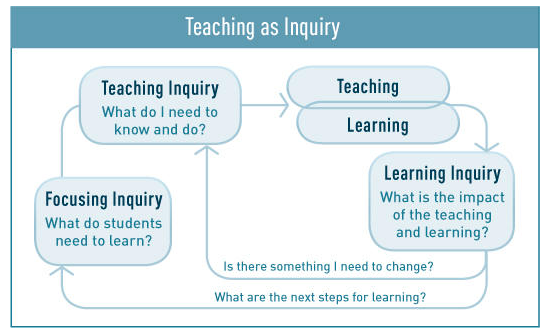
We looked at  Helen Timperley's teacher Professional Learning and Development: Best Evidence Synthesis Iteration (BES) and how it related to our Teaching as Inquiry  model. Different key passages were shown and after some time to think, teachers talked with those sitting near them about what this meant and how it related to our practice. We then shared as a group what the passages meant, and meant for us.

Here are the quotes we discussed.


These were only very short passages from the booklet but formed the basis of some good discussion and hopefully built a shared understanding about our inquiry process.

30 June 2015

What do you do when teaching inquiry is seen as just another thing to do?

Teaching inquiry
 Not another thing we have to do!


Teachers know that to get effective and learning for their students there needs to be collaboration, agency and visible learning.


or


This is the same for our learning as teachers. 

We can have professional development, time to improve our practice in class, then our appraisal, but without being active in our learning we are not going to make the gains in our learning and teaching that are possible. 
Screen Shot 2015-06-26 at 2.54.39 PM.png

As part or our end of year inquiry sharing, I talked about this comparison between our students in class, and our learning as teachers. 
Of course being an active learner means you have a growth mindset and are ready to be challenged and to grow.


26 May 2015

Narrowing Down Inquiry Goals

I saw this hexagon planning frame being used as part of setting up an ALIM Inquiry and thought it was a great way of pin pointing what you are wanting to focus on as a teacher, and the steps to reach this goal.


In this first hexagon flower one of my PRTs I'm coaching put her Inquiry focus.
Around these we put what kinds of teaching acts and activities could possibly achieve this.


We decided on one of these to focus on first and put it in the middle of the next hexagon flower.


Around this we narrowed down even further what she could do to to reach this goal.

The activities and instruction were precise enough that some of them were put into action that week.


Here is an example of some of the statements that compared two well known characters.
The activity has been scaffolded by coming up with the statements together, and discussing as a class where they should go. Then students go away and place statements where they think they should go.


In SOLO terms this is multistructural - students can identify many relevant similarities and differences between the wolf and Little Red.

To get to Relational they will have to be able to give reasons why some of these elements are in the categories they have been placed in.

Shared with Author's permission

One of the teacher's next ideas in the hexagon planning frame was to colour code several of the statements so that students could orally record, then later write explanations. I am looking forward to following this development.