4 August 2015

Learning Pathways in a Digital Environment

I've been looking at the inception of Learn, Create Share as a Manaiakalani teaching and learning pedagogy. Dorothy Burt has a series of wonderful videos explaining this, and the different parts of this process on the Manaiakalani blog.
I was one of the Lead teachers who set up a learning cycles to make learning more visible.


This is from 2009 and used the digital affordances we had available to us then - 6 class imac computers.

 The hook that Learn Create Share using technology, provided for our students, was so successful that we wanted every child to have access to their own device. Thus today we are a one to one school and technology isn't just integrated, it is just the default for learning. In the development of this new digital pedagogy many of the integration scaffolds such as this learning cycle were passed over.

But just recently I was considering whether a cycle of learning like this still has value in our classes.

This learning pathway assumes that there is a limit to how you proceed, such as the teacher's next worksheet, your turn on the computer, your conference with the teacher in writing time or the guided reading text the teacher provided your group. Now however students aren't limited by timing or resources. Through the use of the internet and a class site they can access their learning tasks, scaffolds, texts, rubrics and publishing options any time of the day or night. Instead of a linear path controlled by the teacher, learning looks more like a fountain.


This is the El Alamein Memorial Fountain in Sydney. I thought is showed quite nicely the idea of multiple learning paths.


Teachers Staying Up To Date with Research

     These got pushed around my plate quite a lot as a kid.                                                                                                
Brussels sprout

Then as I grew older  I learnt how good they were for me.
Did you know that 1 cup of brussel sprouts give you 130% of your daily recommended vitamin C? They are also high in fibre, low in calories, help the DNA repair of your white blood cells that fight off infection, are anti carcinogenic, give you 250% of your daily vitamin K that help give you strong bones...... the list goes on. In short they are good for you!

Then I started experimenting with how they could be cooked. Have you tried roasted with a little chilli oil and slivered almonds? What about pan fried with garlic butter or sauteed with bacon? It's all in the presentation (and avoidance of over cooking).

I think that staying up to date with research and recent publications and guidelines can be like this for our staff. If the purpose is clear, and readings are palatable, they can spark lively discussion and either add to or challenge teachers' understanding.

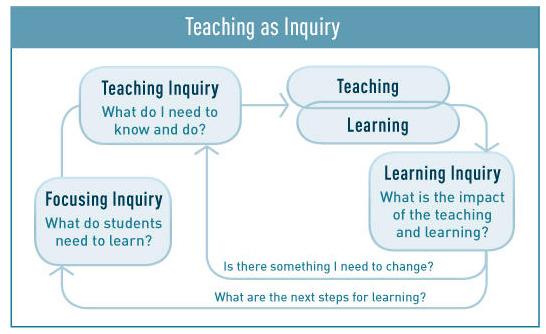
We looked at  Helen Timperley's teacher Professional Learning and Development: Best Evidence Synthesis Iteration (BES) and how it related to our Teaching as Inquiry  model. Different key passages were shown and after some time to think, teachers talked with those sitting near them about what this meant and how it related to our practice. We then shared as a group what the passages meant, and meant for us.

Here are the quotes we discussed.


These were only very short passages from the booklet but formed the basis of some good discussion and hopefully built a shared understanding about our inquiry process.

30 June 2015

What do you do when teaching inquiry is seen as just another thing to do?

Teaching inquiry
 Not another thing we have to do!


Teachers know that to get effective and learning for their students there needs to be collaboration, agency and visible learning.


or


This is the same for our learning as teachers. 

We can have professional development, time to improve our practice in class, then our appraisal, but without being active in our learning we are not going to make the gains in our learning and teaching that are possible. 
Screen Shot 2015-06-26 at 2.54.39 PM.png

As part or our end of year inquiry sharing, I talked about this comparison between our students in class, and our learning as teachers. 
Of course being an active learner means you have a growth mindset and are ready to be challenged and to grow.


26 May 2015

Narrowing Down Inquiry Goals

I saw this hexagon planning frame being used as part of setting up an ALIM Inquiry and thought it was a great way of pin pointing what you are wanting to focus on as a teacher, and the steps to reach this goal.


In this first hexagon flower one of my PRTs I'm coaching put her Inquiry focus.
Around these we put what kinds of teaching acts and activities could possibly achieve this.


We decided on one of these to focus on first and put it in the middle of the next hexagon flower.


Around this we narrowed down even further what she could do to to reach this goal.

The activities and instruction were precise enough that some of them were put into action that week.


Here is an example of some of the statements that compared two well known characters.
The activity has been scaffolded by coming up with the statements together, and discussing as a class where they should go. Then students go away and place statements where they think they should go.


In SOLO terms this is multistructural - students can identify many relevant similarities and differences between the wolf and Little Red.

To get to Relational they will have to be able to give reasons why some of these elements are in the categories they have been placed in.

Shared with Author's permission

One of the teacher's next ideas in the hexagon planning frame was to colour code several of the statements so that students could orally record, then later write explanations. I am looking forward to following this development.

18 May 2015

What does all this PD have to do with my inquiry?


Presented this to staff to show how training and professional development contribute to their teaching inquiry.

11 May 2015

No, Not another Lecture!

Here we are in term 2 and our collaborative inquiry groups have had a re-shuffle.
We have 4 wonderful  PD providers whom I was able to book in for our meeting afternoons, so teachers have been regrouped to make the most of the professional development that suits them.

This is has become a very high PD input term, and not what teaching inquiry is supposed to be so heavily based on. I will have to make sure this is redressed next term. What is also a concern with top down PD, is the impact is has (or doesn't have) on learning for teachers.


This Learning pyramid (from the National Training Laboratory, Bethel Maine), shows different retention rates for training.

What we need to do is make sure that we don't waste teachers' time, and lose opportunities for learning by providing the wrong type of PD. This also applies to  the clever experts we bring in to support out teachers.


The different content areas for the collaborative group meetings include
  • Jannie Van Hees and her research into dialogic classrooms and explicit teaching or writing for year 5-8 students.
  • GaTE definitions and provisions from Core Education aimed at specialist teachers and middle-senior students
  • Junior Literacy acquisition for low decile schools
  • Rubrics for success with Dorothy Burt
This is also supported by PD provided to the staff as a whole in staff meetings on blogging, the SAMR model, and SOLO.

Our PD training is aimed at the top 5 levels, and we are lucky to be able to draw on wonderful trainers and experts from within the school as well as externally to deliver this. My challenge now is to ensure there is practise by doing and teachers sharing this learning.


Soooooo Proud

We finished Term 1 with everyone presenting their learning from their Inquiry into practice so far. There were some sighs, grimaces and jitters leading up to this. But there were also some proud teachers keen to share with the whole staff rather than just a small group.

Staff members were divided into mixed groups of 7-8. I tried to put teachers from different inquiry areas together so that we could all hear about lots of different stories from around the school.

While there were teachers who were used to presenting with edited wonderful movies, slides and tales, this was the first time standing up in front of peers for some of us. Hopefully this will get easier as time goes on.

Each group went off to a room and many shared on screens as they talked about their learning so far.

I had approached several teachers with inquiries I though would be interesting for the whole staff (and of course a couple of very keen presenters who offered) to share in the staffroom to all of us after the groups returned.